The Deposit Records Kit
A renter's move-out file: serve notice by the earlier reading, record the condition, write down the landlord's date with its source, keep a line-by-line deduction ledger, outline a demand letter and know the outlay before filing
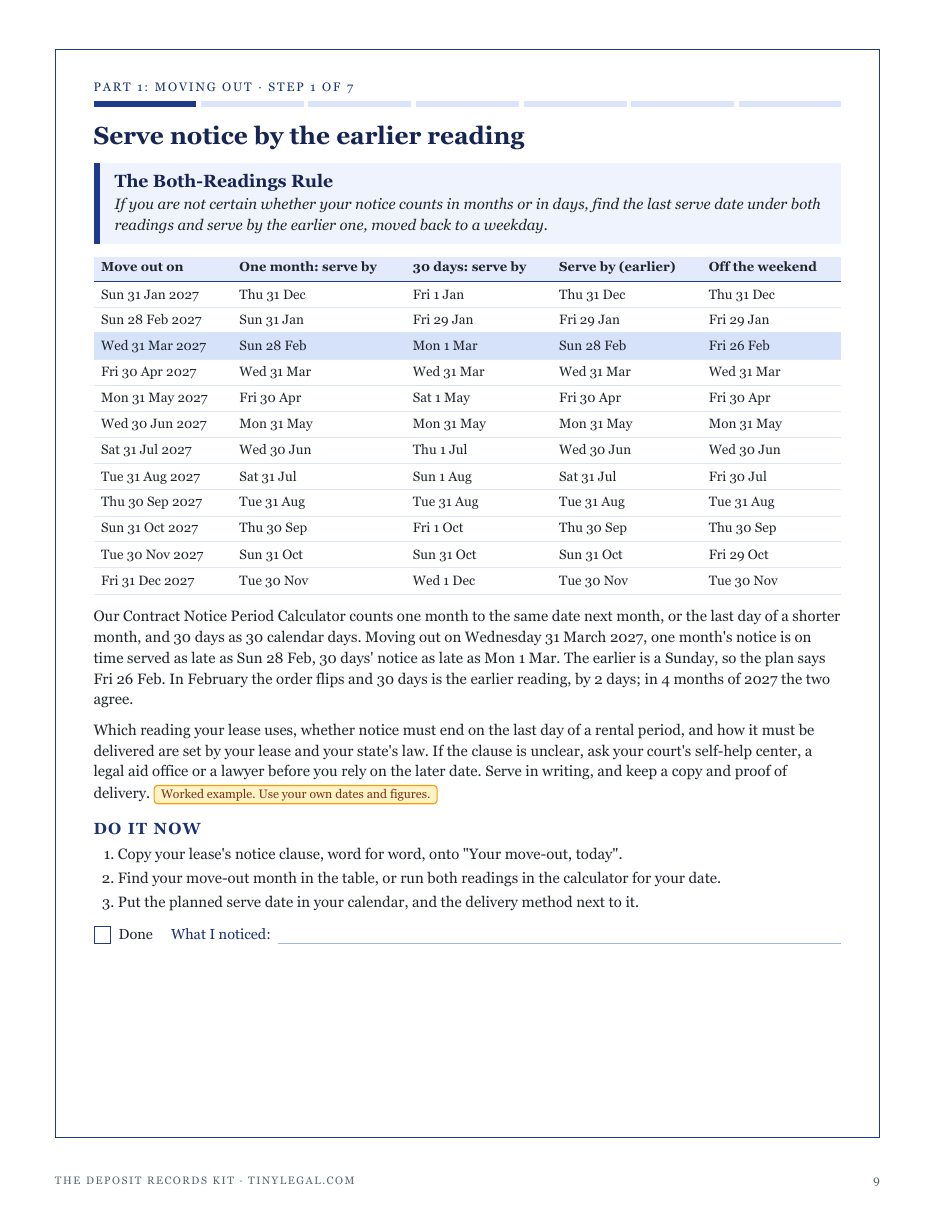
TinyLegal's free tools each answer one question for one moment: the Security Deposit Return Deadline Tracker gives the landlord's date from the window you enter, the Contract Notice Period Calculator gives the day notice takes effect, and the Small Claims Calculator adds up the cost of filing. A move-out is all three moments, weeks apart, and what people are missing when a deposit comes back short is the paperwork that connects them. The Deposit Records Kit turns those tools into one file. Moving out on Wednesday 31 March 2027, one month's notice can be served as late as Sunday 28 February but 30 days' notice as late as Monday 1 March, so the kit serves by the earlier and moves it back to Friday 26 February. It dates the condition on move-out day, writes the landlord's date down with its source, keeps every deduction on its own line ($1,500 paid, $350 deducted, $290 disputed in the worked example), outlines a demand letter of facts, dates and one amount, and lays out the outlay before filing: $130 of example fees breaks even at a $130 award. It is an organizational workbook, not legal advice. It prints no state's deadline, limit or fee: every worked figure is an example, and a working page holds your state's figures with where each came from and the date you checked. It never says whether a deduction is lawful, whether you have a case, or what a court would award, and it sends those questions to the court's self-help center, legal aid or a lawyer. Consult a lawyer; limitation periods have exceptions and can be shorter. Included: 25 printable pages (seven steps, five working pages, a return-date table for 2027 and a quickstart) and a personalised sheet worked from the figures you enter in the notice, deposit and small-claims tools.
Look inside
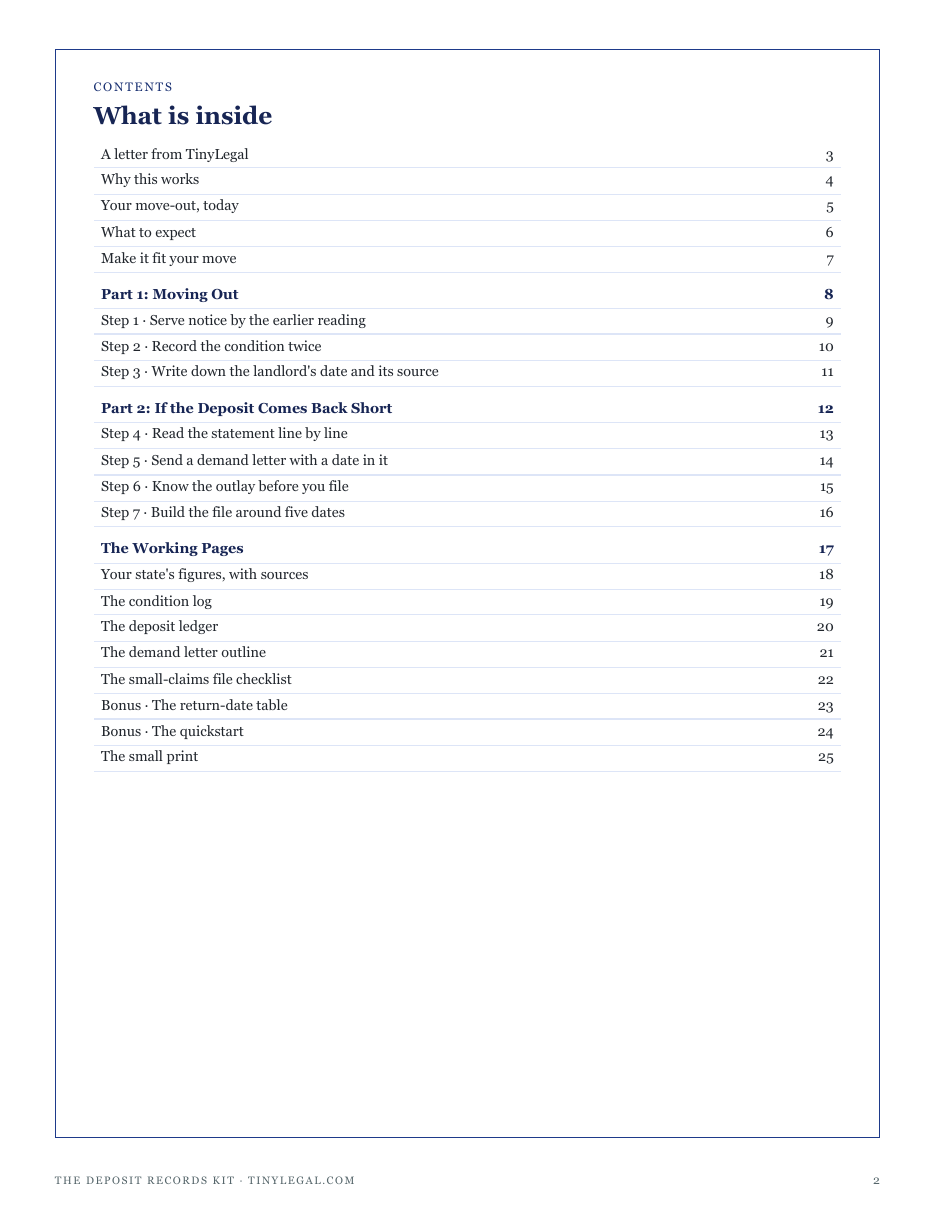
Two full pages from the kit, exactly as printed. Click either to read it at full size before you decide.
What is in it
- The Both-Readings Rule: the last serve date for one month's and 30 days' notice, for every month-end of 2027, moved back to a weekday
- The Same-Angle Rule: a move-out condition record from the move-in corners, planned backwards from the move-out date
- The Source-and-Date Rule: the landlord's date under example windows, weekends flagged and never moved
- The Line-by-Line Rule: a deduction ledger that records your decision on each line and adds up both ways
- The Facts-Dates-Amount Rule: a demand letter with a date to pay by, no legal conclusions and no threats
- The Outlay-First Rule: filing, service and other costs, the arithmetic at three awards, and the break-even award
- The Earliest-Date Rule: a court file built around five dates, and why the limitation period comes from a lawyer
- Five working pages: your state's figures with sources, a condition log, a deposit ledger, a demand letter outline and a small-claims file checklist
- A return-date table for 2027 and a quickstart that closes the score loop
- A personalised sheet worked from the figures you enter in the notice, deposit and small-claims tools
- ✓ 25 printable pages
- ✓ 10 sections, worksheets and templates
- ✓ A second PDF worked out from the numbers you enter
- ✓ No account needed, just an email address
- ✓ Instant download; link valid 7 days
Price includes any taxes. Sold by GrabURL, who handle checkout and support. The charge appears on your statement as GrabURL.
The kit picks up where the free Security Deposit Return Deadline Tracker leaves off. The tracker gives the landlord's date from the window you enter; the kit uses the Contract Notice Period Calculator to find the notice date both readings of a lease accept, keeps a line-by-line deduction ledger, outlines a demand letter of facts, dates and one amount, and runs the Small Claims Calculatorfor the outlay before anyone files. It is an organizational workbook, not legal advice: it prints no state's deadline, limit or fee, never says whether a deduction is lawful or whether you have a case, and sends every such question to your court's self-help center, a legal aid office or a lawyer. Consult a lawyer about limitation periods; they have exceptions and can be shorter.